
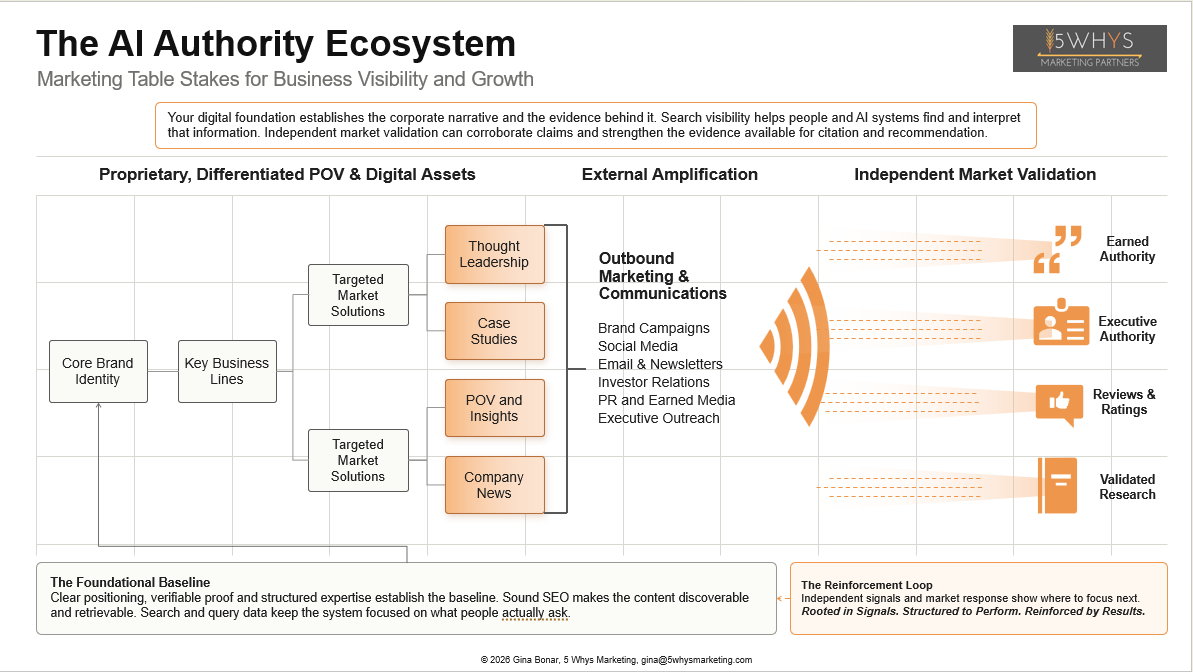
Marketing Table Stakes for Business Visibility and Growth
AI authority describes how clearly and credibly AI systems can identify, understand, corroborate, and recommend an organization when answering relevant questions. It develops through an interconnected system of structured website content, sound SEO, differentiated expertise, external communications, and independent market validation.
AI authority is not a universal score or technical setting. It reflects the evidence available to AI systems and how consistently that evidence appears across owned and third-party sources.
What Is AI Authority?
AI authority is the strength of the evidence connecting an organization to a topic, market, solution, or area of expertise.
When someone asks an AI platform to compare providers, recommend a solution, or explain who has expertise in a category, the system may synthesize information from company websites, search results, media coverage, professional profiles, reviews, research, and other available sources.
The organization with the best website does not automatically appear. The organization with the strongest real-world reputation may also remain invisible if it has never translated that reputation into accessible digital evidence.
The AI Authority Ecosystem provides a framework for closing that gap.
How the AI Authority Ecosystem Works
The ecosystem connects the information a company controls with communications and external signals that strengthen its credibility.
The Foundational Baseline
AI authority begins with clear brand positioning, defined business lines, targeted market solutions, and verifiable proof.
Good SEO remains part of this foundation. It helps search engines and AI systems access, interpret, and retrieve content. Keyword and search-query data also force an organization to focus on what customers are genuinely asking rather than what internal teams assume they want to know.
Structured content, technical accessibility, and accurate entity information create the conditions for broader AI visibility. They do not guarantee it.
Proprietary, Differentiated POV and Digital Assets
A strong website should contain more than general descriptions of products and services. It should demonstrate what the organization knows, how it approaches problems, and why its perspective differs from competitors.
These digital assets may include:
- Targeted solution pages
- Thought leadership
- Case studies
- Proprietary points of view
- Original research
- Company news
- Detailed answers to customer questions
If the content on a company’s website could appear unchanged on a competitor’s website, it probably doesn’t go far enough in evidence, proof, and a clear POV.
External Amplification
Valuable expertise must reach the market before it can build meaningful authority.
External amplification may include brand campaigns, social media, email and newsletters, investor relations, public relations, earned media and executive outreach. These activities help people discover the company’s perspective and create opportunities for others to discuss, quote, reference, and validate it.
Independent Market Validation
Third-party signals can corroborate what an organization says about itself.
Relevant signals may include things like:
- Media coverage
- Expert citations
- Executive speaking opportunities
- Industry recognition
- Reviews
- Ratings
- Partner commentary
- Independently validated research
AI systems do not “trust” these sources exactly as people do. They identify and weigh patterns of available evidence. Consistent third-party references can strengthen the connection between an organization and the expertise, services, or outcomes it claims.
The Reinforcement Loop
Authority grows when external proof feeds back into the organization’s digital foundation.
A company can incorporate earned coverage, awards, customer evidence, research findings, executive appearances, and other validation into relevant website pages. Analytics and AI visibility monitoring can then show which topics are gaining traction, where evidence remains thin, and what the organization should strengthen next.
The result is a measurable, self-reinforcing system.
How Is AI Authority Different From SEO?
SEO improves discoverability, relevance, and retrieval. It remains essential to both traditional search and answer engine optimization, or AEO.
AI authority expands the objective beyond rankings. It considers whether an organization appears in AI-generated answers, how it is described, which sources support the description, and whether the system includes it in comparisons or recommendations.
Strong SEO does not automatically produce AI authority. Weak SEO can still make broader AI visibility significantly harder.
How Can an Organization Assess Its AI Authority?
Start with a simple search, audit, and build process:
- Ask several AI platforms questions customers might ask about your category, problems, and solutions.
- Record whether your organization appears, how it is described, and which sources support the answer.
- Audit the credible assets you already possess, including research, reviews, awards, case studies, media mentions, and executive expertise.
- Identify gaps between your real-world reputation and your digital representation.
- Build the missing links and/or link to existing content and third-party signals, then monitor how the results change.
Being absent is also a finding. An organization may have valuable expertise and credibility that has never been activated digitally.
The Short Version of AI Authority Strategy
AI authority grows from connected evidence. A clear and technically sound website establishes the foundation. Differentiated content demonstrates expertise. Marketing and PR extend that expertise into the market. Independent sources validate it. Measurement and ongoing improvement reinforce the entire system.
Rooted in Signals. Structured to Perform. Reinforced by Results.
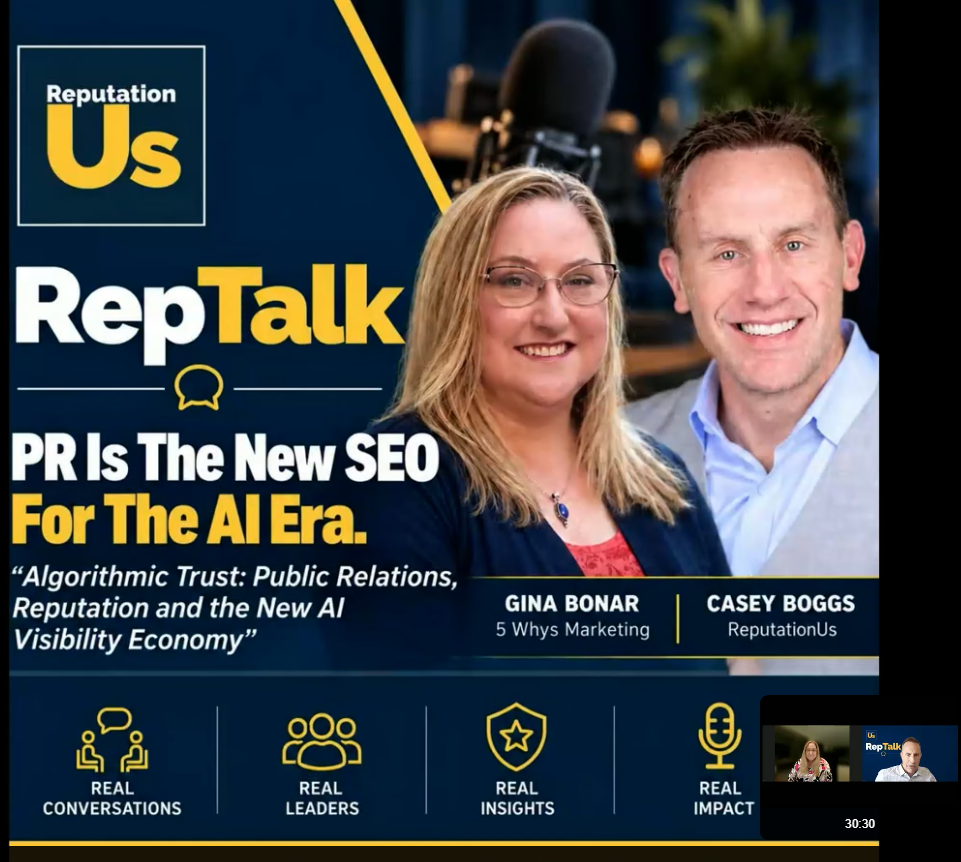
Want to hear a webinar on this topic?
Ready to explore the opportunities?
Frequently Asked Questions About AI Authority
AI authority describes how strongly available digital evidence connects an organization with a topic, solution, or area of expertise. It influences whether AI systems can identify, describe, cite, or recommend the organization in relevant answers.
No. Answer engine optimization focuses on improving content for discovery and retrieval within AI-generated answers. AI authority also considers reputation, differentiated expertise, third-party credibility, and consistent evidence across multiple sources.
Yes. SEO helps make content accessible, understandable, and aligned with demonstrated search demand. It also helps organizations identify the questions people ask. AI visibility extends the objective beyond search rankings to inclusion, citation, and recommendation.
Schema markup can help machines understand content and organizational relationships. It is a useful technical foundation, but schema alone rarely creates authority. The underlying content and supporting evidence must still be clear, relevant, and credible.
Independent sources can corroborate an organization’s claims and strengthen the evidence linking it to specific expertise or outcomes. Examples include media coverage, reviews, research citations, awards, and expert commentary.
Yes. A company may be highly respected by customers, employees, and industry peers while having little accessible digital evidence of that reputation. The opportunity is to operationalize its existing credibility through owned content, external communications, and third-party validation.
Timing varies by market, competitive landscape, existing reputation, and the quality of available digital evidence. Technical improvements may appear relatively quickly, while original research, earned media, executive authority, and other external signals usually require sustained effort.